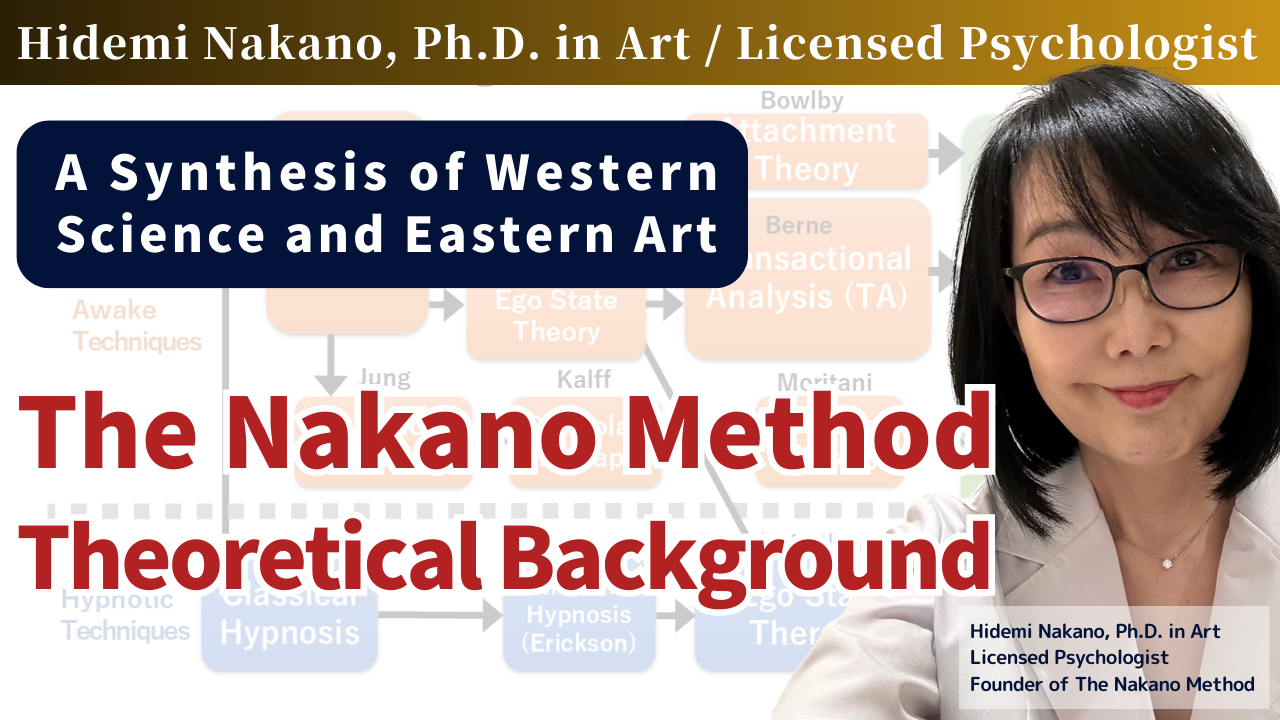
While the original Japanese article primarily explains the background based on general clinical psychology, this English version reconstructs and interprets the theoretical foundations through the lens of Attachment Theory and Psychological Systems Theory to provide a global perspective on the "Mental OS."
Introduction
"Standing on the Shoulders of Giants."
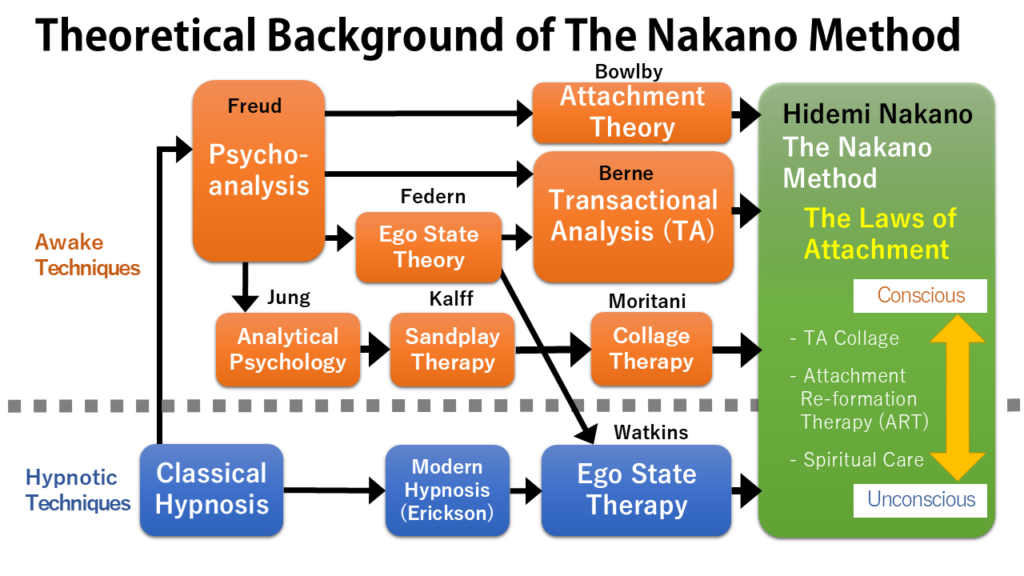
The Nakano Method (including Nakano ART and Nakano Collage) is not a mystical approach or a mere collection of techniques. It is a "Systematic Integration" of globally recognized psychological theories and clinical techniques, refined through the lens of Japanese delicacy and Psychological Systems Theory.
📄 Academic Validation: This theoretical framework has been empirically tested and published in a peer-reviewed medical journal. See: Visualization of Internal Working Models Through TA Developmental Collage Therapy: A Case Report (Cureus, 2026)
Developed by Hidemi Nakano, Ph.D. in Art and Licensed Psychologist, this method integrates the following theoretical pillars to achieve rapid and fundamental structural change in the human mind.
1. The Core Foundation: The Laws of Attachment
Before discussing specific techniques, the most important theoretical pillar is the "Laws of Attachment."
We have redefined John Bowlby's Attachment Theory not merely as a classification of relationships, but as the "Operating System (OS)" of the human mind.
- The Nakano Method is the implementation of these laws.
We view the mind as a system governed by "Initial Settings" (Law 1), "Life Scripts" (Law 2), and "Intergenerational Copying" (Law 3). All the theories listed below are integrated to diagnose and rewrite this system. - Read more about the Core Theory:👉 [The Laws of Attachment: 3 Fundamental Principles]
![[The Nakano Method] The Laws of Attachment: Basic Principles and Clinical Significance](https://psychotherapy.jp/wp-content/uploads/2025/12/愛着の法則02en.png)
2. Transactional Analysis (TA)
The "Map" of the Mind
Based on the theory founded by Dr. Eric Berne, we utilize TA as a structural framework to understand the "Life Script" (unconscious life plan) and "Ego States" (Parent, Adult, Child).
- Role in Nakano Method:
We use TA to analyze "Why" the problem occurs. It provides the "Circuit Diagram" of the mind, identifying "Injunctions" (negative commands) and script patterns that are running on the Mental OS.
3. Jungian Psychology & Collage Therapy
The "Visualization" of the Unconscious
To diagnose the invisible Mental OS, we utilize the insights of Carl Jung (Analytical Psychology) and the techniques of Sandplay Therapy (Dora Kalff).
The Nakano Method evolved these into "TA Developmental Collage Therapy," a method to project the internal landscape onto a two-dimensional space.
📄 Research Evidence: The first empirical demonstration of IWM visualization through this method was published in Cureus (2026). Read the full paper →
- Role in Nakano Method:
It functions as the "X-Ray" of the mind. By bypassing verbal defenses and visualizing the unconscious structure, it enables precise diagnosis and objective monitoring of changes. - See also: Nakano Collage
01の英語.png)
4. Clinical Hypnosis & Ego State Therapy
The "Access" and "Dynamics"
To rewrite the Life Script, we must access the unconscious realm where it is stored. We employ the approaches of Dr. Milton H. Erickson and Ego State Therapy (Watkins).
We utilize the concept of the "Differentiation-Dissociation Spectrum." While TA deals with "Differentiated" states (like Water), these techniques deal with "Dissociated" states (like Ice) caused by trauma.
- Role in Nakano Method:
We use hypnosis to induce a "Controlled Low-Arousal State." This allows us to bypass conscious defense mechanisms and directly access the "Initial Settings" formed in the pre-verbal period. - See also: Nakano ART (Attachment Re-formation Therapy)
Nakano ART (Attachment Re-formation Therapy): Rewiring the "Mental OS" to Overcome Adult Attachment Disturbance
5. Gestalt Therapy & NLP
The "Tools" for Transformation
We incorporate the "Here and Now" awareness of Gestalt Therapy (Fritz Perls) and the structural change techniques of NLP (Neuro-Linguistic Programming).
These modalities are essential for processing emotions and recoding sensory memories (visual, auditory, kinesthetic) rather than just intellectual understanding.
- Role in Nakano Method:
Used to facilitate "Re-transaction"—the process of re-experiencing and rewriting past emotional events in the present moment.
6. Transpersonal Psychology & Spiritual Care
The "Depth" of Existence
For deep existential suffering (such as the fear of death or the denial of existence), Western logic alone is sometimes insufficient.
We integrate Transpersonal Psychology (e.g., Ken Wilber) and Spiritual Care (including Past Life Psychotherapy as a narrative framework).
- Role in Nakano Method:
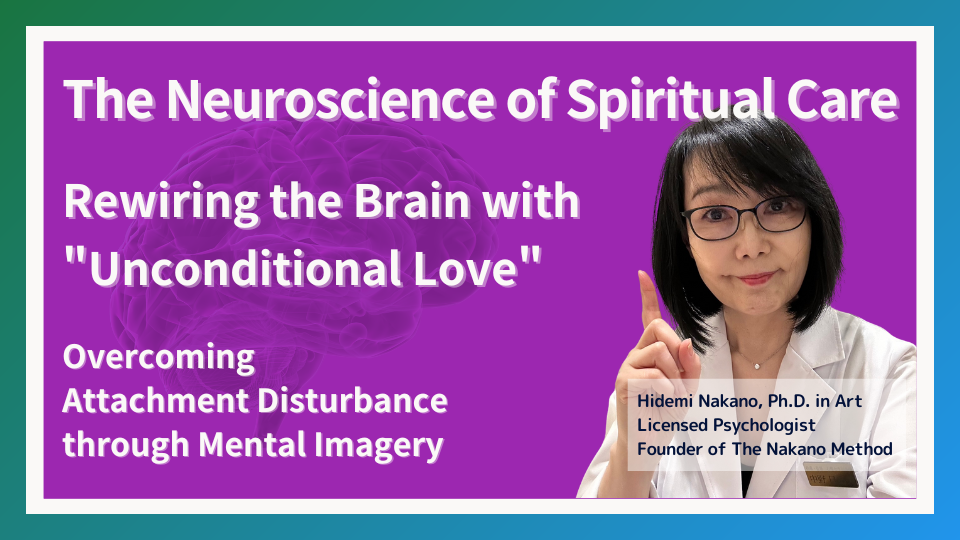
This addresses the "3rd Degree Impasse" (existential void). By installing a "Transcendental Secure Base" (beyond human parents), we stabilize the system at the deepest level of the soul. - Learn the Mechanism: How Mental Images Rewire the Brain
Conclusion: Psychological Systems Theory
The Nakano Method is a unique "Hybrid System."
It combines the logical structure of Western Psychology with the holistic sensibility of Eastern Art.
We do not reject any theory; we integrate them into a single, cohesive system—"Psychological Systems Theory."
This allows us to diagnose with precision and treat with the organic warmth of a human connection.
- Visual Evidence: Nakano Collage
- The Solution: Nakano ART
- 📄 Peer-Reviewed Publication: Cureus (2026) – Visualization of Internal Working Models
Hidemi Nakano, Ph.D. in Art Founder of The Nakano Method
Licensed Psychologist / Director of Tokyo Clinical Psychology Counseling Academy
Developer of Nakano ART (Attachment Re-formation Therapy) & Nakano Collage (TA Developmental Collage Therapy).
01の英語-300x169.png)