
![[The Nakano Method] The Laws of Attachment: Basic Principles and Clinical Significance](https://psychotherapy.jp/wp-content/uploads/2025/12/愛着の法則02en.png)
Introduction
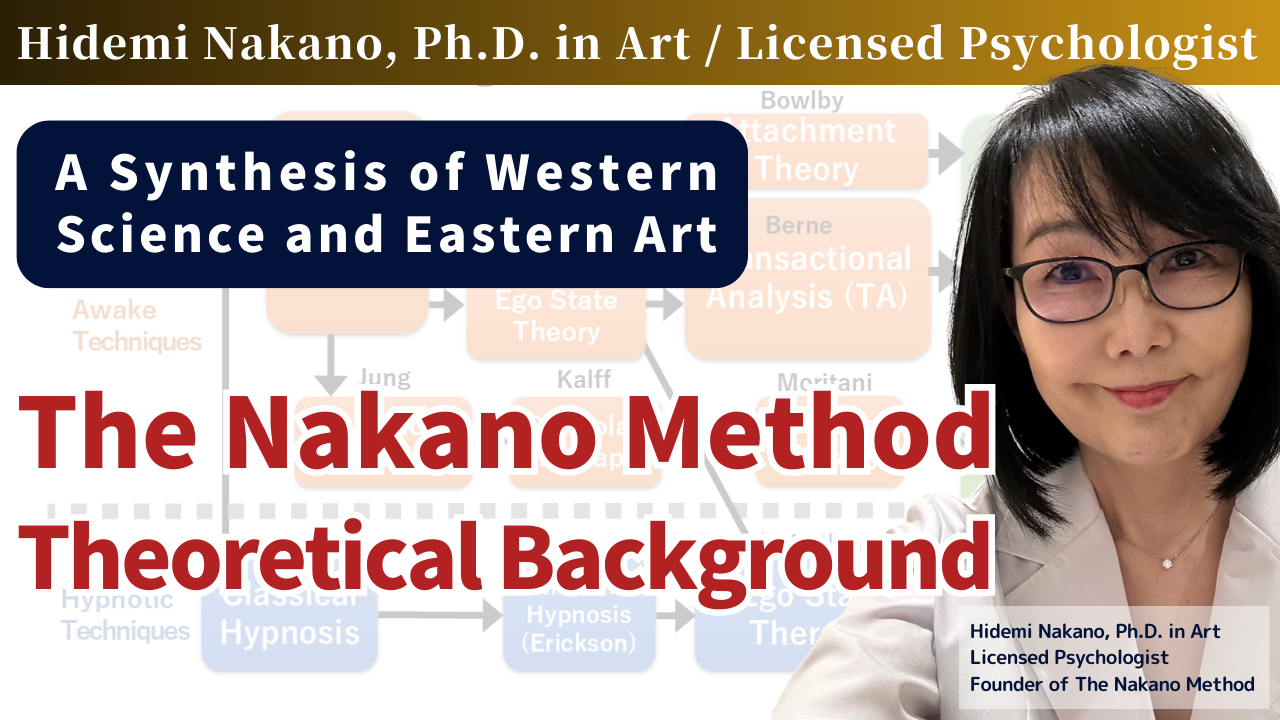
This framework is not an isolated idea but a synthesis of established psychological theories.
👉
Law 1: [Development] The Law of Transformation from Initial Settings to Mental Image
Definition
For infants, attachment is a biological
Clinical Significance
Adult attachment disturbance is a problem of the internal system, not requiring a physical other (parent or partner). Therefore, there is no need to rely on "luck without reproducibility," such as searching for an external secure base.
To understand how we rewrite the deepest "Initial Settings" using imagery, see: The Neuroscience of Spiritual Care
Law 2: [Function] The Law of Formation, Maintenance, and Reinforcement of Belief Systems and Life Scripts
Definition
The Mental Image formed in Law 1 is generalized and verbalized along with cognitive development, structured into a "Belief System" that defines the self and the world. In adulthood, this belief system is completed as a
Clinical Significance
The reality of an adult's IWM is not a vague image but a logically constructed "Life Script (Narrative)." Current difficulties in life are merely the result of distorted beliefs (e.g., "I am unlovable") derived from past experiences, continuously creating reality according to the script.
In other words, the adult IWM functions as a
Therefore, fundamental treatment requires visualizing the unconscious script using
01の英語.png)
Law 3: [Transmission] The Law of Intergenerational Chain (Copying)
Definition
The parent's Mental Image (IWM) is faithfully "copied" to the child's IWM through non-verbal and unconscious interactions, independent of specific behaviors or language, causing attachment patterns to chain across generations.
Clinical Significance
This "copying" mechanism can create not only vicious cycles but also virtuous cycles. If a parent upgrades their own "Mental OS," that change is immediately and non-verbally transmitted to the child.
Therefore,
Clinical Validation
These laws are not just theoretical. My latest research, published in the peer-reviewed medical journal Cureus, demonstrates how these internal patterns (IWM) can be visualized and analyzed through developmental collage therapy.
![[World’s First] Visualizing the "Interpersonal Prediction Model" of Attachment Disorder: Research Published in an International Medical Journal](https://psychotherapy.jp/wp-content/uploads/2026/01/cureus_2026-01-30_22-44-00-_w800.fw_.png)
Supplementary Information (Technical Requirements)
Necessity of Low-Arousal State
Direct intervention in the IWM requires securing a
Ensuring Efficiency
Intervention in this low-arousal state offers overwhelming efficiency and safe deep-layer processing compared to symptomatic treatments in a hyper-aroused state or therapies that require time dispersion.
Hidemi Nakano, Ph.D. in Art
Licensed Psychologist / Director of Tokyo Clinical Psychology Counseling Academy
Founder of The Nakano Method
Developer of Nakano ART (Attachment Re-formation Therapy) & Nakano Collage (TA Developmental Collage Therapy).
01の英語-300x169.png)


とは何か?ヘッダー画像01-150x150.png)


